


Review
Nueva Vivienda:
New Housing Paradigms in Mexico
REVIEW BY: CARLOS A. REIMERS




REVIEW BY: CARLOS A. REIMERS
July 25, 2025
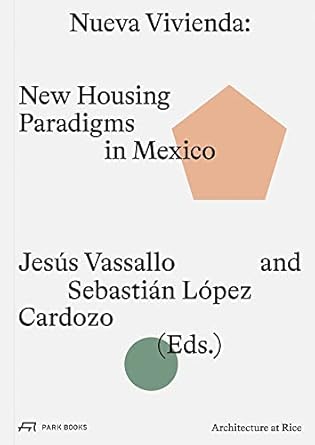
Nueva Vivienda: New Housing Paradigms in Mexico explores contemporary housing in Mexico, with emphasis on cultural dialogue in architectural innovation. Published by Rice Architecture and Park Books, this volume is part of Architecture at Rice (a series active for sixty-three years), edited by Rice associate professor Jesús Vassallo and Sebastián López Cardozo, a practicing architect in Toronto who was then a Rice graduate student. The book emerges from the conference “Disrupting Housing: New Paradigms in Mexican Collective Living,” held at Rice Architecture in March 2020.
The book is divided into three main sections, featuring an essay by Surella Segú and Armando Hashimoto (founders of the collaborative practice El Cielo—https://www.elcielomx.com/), three in-depth topical sections with selections of dialogues between the editors and presenters, supported by images of twenty-two architectural works showcased at the conference, and an incisive conclusion by the editors. This structure highlights connections between the discussed ideas, notions, and concepts, while suggesting potential paths for the future of housing.
The opening essay by Segú and Hashimoto, “What Collective? Mass Housing and Representation in Mexico,” serves as a pivotal introduction. It provides a necessary comprehensive summary of the social, cultural, and disciplinary context of more than a century of changes in housing policy and urban development in Mexico. The authors trace housing, from midcentury government and labor union projects to the more recent private developer-led models. They highlight Mexico’s contributions to global architectural ideas, illustrating the complex interplay between housing’s collective representation and individual needs. This is the book’s most compelling argument: the intellectual exportation of architectural ideas from Mexico, challenging the narrative of architectural knowledge flowing predominantly from the Global North to the Global South.
Contemporary Mexican housing began with the Spanish colonial urban courtyard house, which evolved at the beginning of the twentieth century into the vecindad, a type of communal housing arrangement. A typical vecindad involved several households occupying the different dependencies of the colonial house and sharing common spaces like courtyards and laundry areas. Although vecindades were a self-managed response to urban densification, they were often viewed as overcrowded and unsanitary, prompting the need for alternative housing solutions. In the second half of the twentieth century, the essay identifies three stages in housing evolution. Between the 1950s and 1960s, the central government is involved in producing modern massive collective housing projects in response to rural-urban migration driven by industrialization. Simultaneously, informal settlements in peri-urban areas, known as colonias populares in Mexico, emerged driven by the unmet demand for public housing. The second stage, from the 1970s to 1980s, saw shared responsibility between the government (through the Institute of the National Housing Fund for Workers—INFONAVIT) and labor unions. This shift emphasized community building and equitable urban development, aiming to provide inclusive living environments with local amenities and public spaces. The third stage, from the 1990s onwards, saw the liberalization of public policies, reducing government participation to funding while private developers took over housing production. This shift led to housing sprawl on the periphery, with poor city integration, long commutes, struggles by local governments to provide the necessary infrastructure and services that eventually end up in some of the housing remaining unoccupied or abandoned. Throughout these stages, informal areas kept absorbing much of the unmet housing demand. Recent housing initiatives have supported self-construction with technical guidance, but the authors argue that the approach fails to address broader urban and environmental issues.
The topical dialogues are organized around three scales of housing: single-family homes, infill development, and high-rise buildings. This classification breaks down housing into discrete categories, even if some overlap occurs (e.g., work by Estudio MMX in the single-family category also fits infill development). These thought-provoking dialogues offer readers nuanced insights into principles and practices shaping contemporary Mexican housing, revealing the challenges and opportunities faced by architects and their design philosophies within the sociopolitical context in which they operate. The twenty-two housing projects featured with the dialogues showcase the creativity of a new generation of Mexican architects, including Luís Aldrete, Anonimous+G3 (Alfonso Enciso and Alfonso Garduño), Héctor Barroso, Ambrosi Etchegaray (Jorge Ambrosi and Gabriela Etchegaray), Macías Peredo (Salvador Macías and Magui Peredo), MMX (Diego Ricalde), and Re Urbano (Rodrigo Rivero-Borrell and Alberto Kritzler).
At the core of the book, Vassallo and López Cardozo emphasize the notion of housing as a dialogue, highlighting that it’s about creating spaces for human interaction and community building. This dialogue is both universal and local, reflecting shared human experiences rooted in specific cultural, climatic, and social contexts. In their conclusion, “Deindividualized Building: A Generation’s Contribution to Housing,” the editors reflect on the broader implications of the projects and the contributions of this new generation of Mexican architects. They emphasize the importance of collective efforts and the need for a balance between private innovation and public good, advocating for a more inclusive approach to urban planning. This approach recognizes the contributions of architects, scholars, and community members in shaping the built environment, essential for addressing the complex challenges of contemporary urban living, from inequality and social justice to environmental sustainability.
Visually, Nueva Vivienda is aesthetically pleasing, featuring high-quality photographs, drawings, and thoughtfully composed layouts. However, floorplans, sections, and elevations would benefit from architectural conventions to better understand the projects. Floorplans lack reference to general orientation, and there is little information about the context of the projects, making it difficult to understand their immediate and general surroundings, or their dialogue with the built environment, an important topic in the book’s discussions. Some project locations are incorrect (e.g., Casa Tello by Productora is in Cuernavaca, not Puerto Escondido). Architectural drawings presented at 1:400 scale are challenging to appreciate without graphic scales or indication on the use of spaces. Photographs are well-sized but lack captions, complicating identification of the depicted spaces or details. Future editions could review the graphic content, as it constitutes 60 percent of the book and is vital for an architectural audience. This said, readers can find these details in several online architectural sites.
The book also missed a guest that is difficult to ignore. This is especially important since, beginning this century, more than 60 percent of Mexican households lived in poverty and extreme poverty (less than US$2.30 per day). As vecindades disappear from Mexican cities, colonias populares are the only accommodation for this population. The professionals and academics involved in understanding and improving living conditions in informal areas in Mexico could have made a significant contribution to the book. As argued, the future of housing lies in integrating formal and informal approaches, fostering an inclusive and sustainable urban development. The future of many Latin American cities depends on this.
Nueva Vivienda holds particular significance in the American context, where housing issues are often market-driven. The book’s emphasis on collective expertise, cultural dialogue, and innovative design offers valuable insights for scholars, practitioners, architects, planners, and policymakers. It serves as a reminder that housing is not just a commodity but a fundamental aspect of human dignity and social well-being.
Ultimately, Nueva Vivienda celebrates multiculturalism and international camaraderie through original scholarship, engaging case studies, and thoughtful dialogues. It challenges conventional narratives and highlights the innovative contributions of Mexican architects to global housing discourse, reflecting the interconnectedness of architectural practice across borders. By bringing Mexican architects into conversations intersecting architecture, culture, and social justice, this book fosters a sense of solidarity and shared purpose among architects worldwide.
Carlos A. Reimers, PhD, Intl. Assoc. AIA, is an associate professor in the Department of Architecture, School of Architecture and Planning, Morgan State University. He is an architect and a planner expert on multifamily residential planning and design, affordable and low-cost housing, minimal and emergency housing, and incremental and informal housing in North America, Latin America, and Asia. His research and scholarship have been widely published and his design work has been recognized in the US and Latin America. He is a consultant of BRAC University’s Centre for Inclusive Architecture and Urbanism in Dhaka, Bangladesh. He has been senior adviser for the InterAmerican Development Bank, city governments, NGOs and community organizations working in housing.